Getting Towed for Prolonged Street Parking in San Francisco
A dive into San Francisco's 311 towing data, focusing on 72-hour abandoned vehicle reports
Anyone who owns a car knows the feeling of returning to where they parked, only to find an empty spot. Did my car get stolen, or did it get towed? In SF, the answer is often the latter. Towing fees in SF can easily exceed $700 between the initial tow, the citation, and daily storage fees.
While there are many reasons a car can be towed (street cleaning, blocked driveways, unpaid tickets), one specific category felt uniquely frustrating and fixable: the 72-Hour Abandoned Vehicle report.
I decided to build an app called NoTow to tackle this specific problem. But before writing a single line of code, I looked at the data to understand just how bad the situation was.
My personal experience
I was a recent transplant to San Francisco, and initially hadn’t thought much of the street parking rules besides getting a parking permit. Given I lived in a relatively dense neighborhood, I toughed it out and would utilize street parking, moving my car every few days. It was a hassle but I utilized public transport most of the time and would only really use my car for big hauls or when leaving the city for a weekend. However in the short period I was living here, I racked up several tickets for stuff like parking in a city-reserved street parking or for not turning my wheels the right way, expired registration (not actually just forgot to add the stickers) and eventually the 72 hour notices. On the first tow, I thought I was just unlucky and chalked it up to an unlucky attendant being extra discerning. However, it happened again when visiting family out of town and to make matters worse, it got side swiped and I couldn’t even drive it from the impound lot. I had to get it towed again (an additional cost) to a tow shop and hoped my insurance wouldn’t clean out my wallet. After all the stress that came from that, I decided to just pony up some extra money and pay for private parking. The frustration from having it happen again and having to pay the equivalent of my rent just to get my car back made me want to do something to make sure something like that wouldn’t ever happen again.
At the end of the day, I understand parking enforcement is important and I’m not actually against mechanisms to promote public transport (I have a monthly pass and use it 99% of the time. I commute for work via muni/BART or caltrain and walk/bus everywhere else). However, I think there needs to be a balance on trying to appropriately price the cost of street parking (it’s genuinely underpriced given the value of the sq footage it takes up) and weaponizing a system that exists to make it easier to get around the city.
The Breakdown of Tow Categories
When people submit complaints to 311 regarding vehicles, they can fall into several categories. While blocking driveways and parking in designated zones account for a large volume of immediate tows, a surprisingly high number of reports are for vehicles that simply haven’t moved in a few days.
The “72-Hour Abandoned Vehicle” statute states that a vehicle can’t be parked in the same spot on a public street for more than 72 hours. I imagine the original intention was to prevent stolen/junk cars from rotting on city streets, but in a dense city like SF where street parking is coveted, it’s been weaponized by disgruntled neighbors.
The 72-Hour Trap: By the Numbers
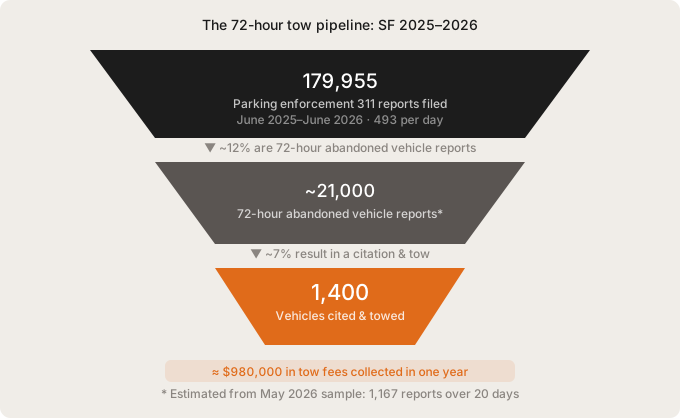
I analyzed the data for a one-year period (June 2025 - June 2026). While only 1% of the 180,000 parking-related 311 reports actually result in a tow, that still equals 1,400 vehicles cited and towed.
That 1% translates to almost a million dollars collected by the city and the tow companies. All due to a minor offense that can easily wreck someone’s finances for the month.
The Problem with the Official System
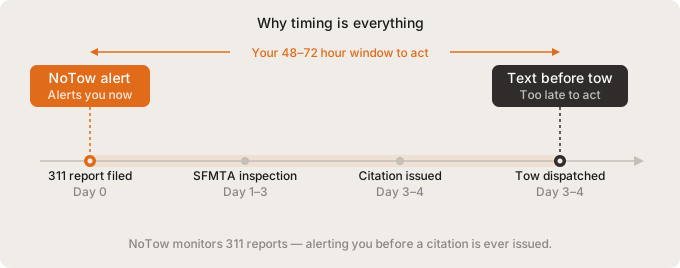
The SFMTA doesn’t natively alert users of a citation or impending tow for their car. However, there’s a program called the “Text before Tow” where after filling out the form, the city will text at the same time that a tow truck is dispatched.
Either due to trying to protect their revenue stream, preventing users from gaming the system or other unknown reason, the text only goes out at the same time the tow truck is on the way not before.
So unless you’re right by your vehicle, it’s unlikely you’ll be able to make it to your car before it gets towed.
How NoTow Stops the Needless Tows
This is where NoTow comes in. Instead of waiting for the SFMTA to officially authorize the tow, it monitors the intent to tow by tracking neighborhood 311 reports as they happen.
The NoTow Early Warning System
Here is how the app works to protect your vehicle:
- Drop the Pin: When you park your car, you open the NoTow app and tap “Protect This Spot.” This securely saves your current location to your device.
- The Match: It cross-references new 311 reports against your active parking coordinates. NoTow uses a 200-foot geofence radius.
- The Alert: If a new 311 report for a “72-hour violation” lands inside your radius, it immediately fires a push notification to your phone: “Alert: A car on your block was just reported for a 72-hour violation. Move your vehicle to avoid a potential tow.”
By giving you a 48 to 72-hour early warning, you have plenty of time to walk out, move your car to a different spot, and completely avoid the $700 nightmare.
Built for Privacy and Peace of Mind
I designed NoTow with safety and privacy in mind:
- No License Plate Lookups: It doesn’t require or store your license plate for tracking.
- No Photos: While this is something that’s available in some cases, it’s something I decided against as the stated purpose of the app is to save people money, not to start a war with their neighbors.
- Simple Alerts: It alerts you of the street name and how close the report was to your car, leaving it unverified but actionable.
Try NoTow Today
NoTow is launching with a 30-day free trial. Try it, let it watch your block, and see the value for yourself. After that, it’s just $5/month or $50/year. A fraction of the cost of a single tow.
Don’t let a neighbor’s 311 report ruin your week. Let NoTow keep an eye on your spot.
In the Age of AI, where is the AI?
Living in San Francisco, it seems as though every single thing you see on billboards or online ads is about how they’re using AI in everything and how it will change things. I personally find LLMs a fascinating piece of technology and it’s already changed the world quite a bit from it’s introduction in late 2022. However, there are dubious incentives driving a lot of the conversations around LLMs and a lot of companies are using it as a buzzword to mask or justify market conditions or failing business models.
In my work as a Product Manager, I try to start from the perspective of customers. And when brainstorming over a given customer pain point, it’s important to think about what would be the best/balanced way to solve that problem. Sometimes the solution does involve LLMs/AI but other times, its simply shoe-horned in simply for the sake of saying that we’re “AI native” or something along those lines. It’s important to take a step back and think about the fundamental problem we’re trying to solve and choosing the right tools for the job. AI or Not.
Currently, NoTow doesn’t feature any AI features (besides in its development) but it’s something I’m exploring for the future in regards to computer vision for improving our detection methods.
Final Notes
If you made it this far, I really appreciate you for taking the time to read this post. I plan to launch this once it clear’s Apples review process and build more things in the future. I’m generally pretty active in trying to do hackathons and build new things so if you’re interested in collaborating on anything in that area, feel free to reach out on Twitter(Yes I still call it Twitter not X). I’m also looking to move into consulting via Kowaa Labs so if you’re interested in working together don’t hesitate to reach out.
Methodology
For the 311 reports related to tows, the category was for those that fell into “Parking Enforcement” only. Look back period was June 8th 2025 to June 8th, 2026